Marcus Webb had built a fortune worth billions, yet none of his wealth could help the one person who mattered most — his eight-year-old son.
After Ryan’s mother abandoned the family months earlier, the boy had fallen completely silent.
Doctors blamed trauma. Therapists called it emotional withdrawal. Marcus only knew one thing: his son hadn’t spoken a single word in twenty-two agonizing days.
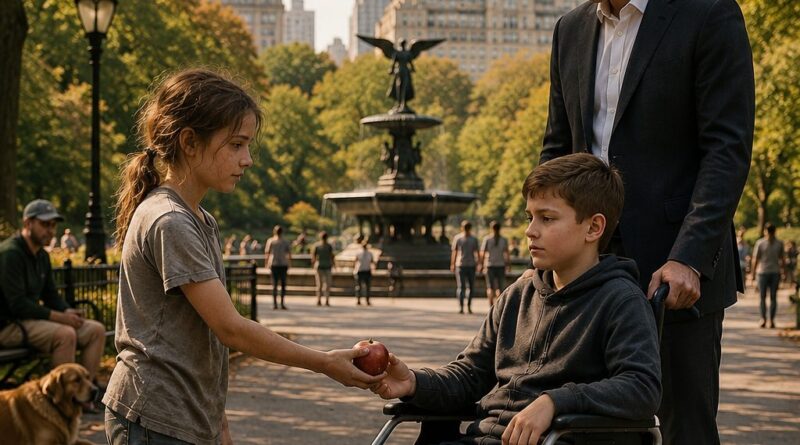
One sweltering Saturday afternoon in Riverside Park, Marcus pushed Ryan’s wheelchair through crowded walkways alive with music, laughter, and the noise of summer.

Ryan sat motionless, staring blankly ahead while Marcus searched desperately for even the smallest sign that his son was still emotionally present.
Then a barefoot girl walked up to them.
She looked no older than twelve, wearing faded jeans and carrying a half-eaten apple in her hand.
Unlike everyone else, she wasn’t intimidated by Marcus’s wealth or uncomfortable around Ryan’s condition. She knelt beside the wheelchair and casually offered him the apple.
“Want some? I only ate from one side,” she said with a grin.
Ryan blinked slowly.
“I’m Callie,” the girl continued. “What’s your name?”
Marcus braced himself for silence.
But instead, Ryan whispered softly, “Ryan.”
It was the first word he had spoken in twenty-two days.
Callie behaved as if nothing extraordinary had happened. She chatted naturally, teased herself about her unusual name, and moments later started dancing to the faint jazz music drifting through the park.
Her movements weren’t polished or professional — but they were fearless, joyful, and completely free.
Ryan couldn’t stop watching her.
“My sister taught me,” Callie explained afterward. “She says sometimes your body understands things your mind refuses to face.”
When Ryan admitted he could still move his arms, Callie encouraged him to move along with the music.
Together, the two children slowly swayed and laughed while Marcus stood nearby in complete disbelief. For the first time in months, his son looked alive again.
Then Callie quietly revealed something deeply personal.
“My sister stopped walking for a while after our dad left,” she said gently. “There was nothing wrong with her legs. She just… stopped.”
Ryan listened carefully as she continued.
“I danced with her every day. Eventually she walked again. Now she runs track at school.”
For the first time since his mother disappeared, hope flickered in Ryan’s eyes.
Before leaving the park, Marcus offered Callie money for helping his son. She refused immediately.
Instead, she asked if her older sister, Jess, could come meet Ryan too.
A few days later, Jess Parker arrived at the Webb mansion alongside Callie and their exhausted mother, Sandra, who worked endless shifts just to keep food on the table. Jess was only sixteen — calm, observant, and remarkably mature.
Marcus noticed immediately how naturally she connected with Ryan.
She didn’t pity him. She didn’t treat him like he was broken. She simply treated him like someone capable of healing.
“Your body already remembers how to move,” Jess told him quietly. “We just have to help it remember again.”
Their sessions started small: breathing exercises, rhythm work, music, shoulder movement, simple stretches. Jess believed trauma didn’t only exist in the mind — it lived inside the body too. Rather than forcing Ryan to speak, she helped him reconnect through movement.
Slowly, everything began to change.
Ryan started talking during dinner again. Sometimes he laughed. Sometimes he joked with Callie. Week after week, Marcus watched his son slowly come back to life.
Even Marcus’s mother, Patricia — a woman who trusted diplomas more than instinct — eventually admitted she had underestimated Jess.
The girl had no credentials, no formal education, and no wealth. Yet Ryan improved more with her than with any specialist money could buy.
Soon, Ryan’s neurologist noticed the dramatic progress as well. Amazed by the results, she asked Jess where she had learned her methods.
Jess answered honestly.
“I needed it myself first,” she said. “Then I figured out why it worked.”
The doctor became so impressed that she began referring other children struggling with trauma.
That was when Marcus realized this was bigger than Ryan. Jess and Callie had discovered something truly powerful.
So Marcus made Sandra an offer: he would fund a movement-therapy studio where Jess could help children heal through rhythm, trust, and connection.
Sandra hesitated at first, wary of rich people offering charity with hidden conditions. But Marcus reassured her gently.
“You already gave me the only thing I wanted,” he said, watching Ryan laugh with Callie down the hallway.
A few weeks later, the studio opened.
Children who had once shut themselves off from the world slowly began reconnecting through music and movement.
Callie helped during sessions with her warmth and endless humor, while Jess quietly guided wounded children back toward themselves.
Then, eight months after that life-changing day in Riverside Park, the impossible happened.
During an ordinary Tuesday session, Ryan stood up on his own.
At first, only for a moment.
Then a little longer.
Marcus sat frozen in the corner as his son took one trembling step forward… then another.
Across the room, Callie erupted into the most ridiculous celebratory dance imaginable — completely offbeat and wildly dramatic.
Ryan burst into uncontrollable laughter.
Then he walked straight toward her, wrapped his arms around her tightly, and Marcus covered his face as tears streamed down his cheeks for the first time in years.
Months later, during the studio’s spring showcase, Ryan stepped onto the stage without his wheelchair and performed in front of a packed audience.
The routine wasn’t flawless — and that imperfection made it even more meaningful. Every child in that room had battled their own pain and fought hard to reclaim a piece of themselves.
After the performance, Marcus stood silently near the back of the studio, listening to his son’s laughter echo through the crowd.
For the first time in years, he felt completely at peace inside.
Not because of wealth.
Not because of power or achievement.
But because one barefoot girl holding an apple had paused long enough to truly see his son — when everyone else had simply kept walking.