The Boy Scattered Cash Across the Bank Floor… Then Spoke of the Fire
The downtown bank lobby shone with wealth.
Polished marble floors.
Brass teller windows.
Sunlight streaming through a glass façade.
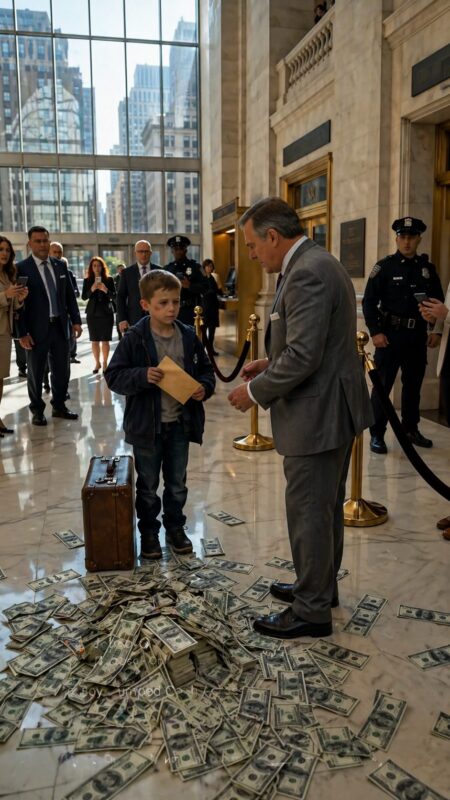
Clients in tailored suits waited behind velvet ropes, checking their watches while pretending not to notice one another. Keyboards clicked softly. Heels echoed across the stone.
Then a suitcase slammed onto the floor.
Bang.
A small boy dragged a worn, battered case into the center of the lobby and dropped it with both hands. The latch snapped open.
Cash burst everywhere.
Bundles of bills flew into the air. Stacks slid across the marble beneath polished shoes. A woman screamed. Someone dropped a briefcase.
Within seconds, the room dissolved into chaos.
The moment seemed to spin—shocked faces, swirling money, guards reaching for radios—until everything settled on the boy.
Eight years old.
A dirty face.
An oversized jacket hanging loosely from his shoulders.
Mismatched shoes.
And somehow… the calmest person in the room.
A female teller rushed forward, her glasses slipping down her nose.
“Kid! What is this?!”
The boy didn’t flinch.
He didn’t try to gather the money.
He didn’t even look down.
“I need to make a deposit.”
The words hit harder than the suitcase.
The lobby fell into an uneasy silence.
A man in a navy suit slowly raised his phone. Another stepped away from the scattered cash as if it might be dangerous. Security guards edged closer, alert but unsure.
Then an office door opened.
The bank manager stepped out.
In his fifties. Perfectly dressed. A controlled smile—the look of a man used to solving problems instantly.
He saw the money first.
Then the boy.
Then the boy’s face.
Everything changed.
The color drained from his skin.
The smile vanished.
The guards noticed immediately. So did the clients.
The boy reached into his jacket and pulled out a folded envelope—old, worn, handled too many times.
He held it out.
“My mother said to give this to you.”
The manager didn’t move.
For a moment, it looked like he might run.
Then pride pushed him forward.
He took the envelope with trembling fingers.
The room watched in complete silence. Even the last bills sliding across the floor sounded loud.
The manager opened it.
Read the first line.
His breath stopped.
“No…”
The word came out small. Broken.
The boy stared at him, unblinking.
“She said you’d remember the fire.”
A wave of shock moved through the lobby.
The guards exchanged looks. A wealthy client slowly lowered his phone, suddenly unsure whether recording was wise.
The manager’s hand shook so badly the letter nearly slipped.
He wasn’t looking at a child anymore.
He was staring into the past.
Smoke.
Flames.
A locked door.
Something buried.
The boy stepped forward slowly. Cash still drifted lazily around his feet.
The tension thickened.
The manager whispered:
“She can’t…”
The boy leaned in slightly—just enough to be felt by everyone watching.
Then he spoke six words that froze the entire room.
“She’s alive.”
The manager stumbled backward into the velvet rope.
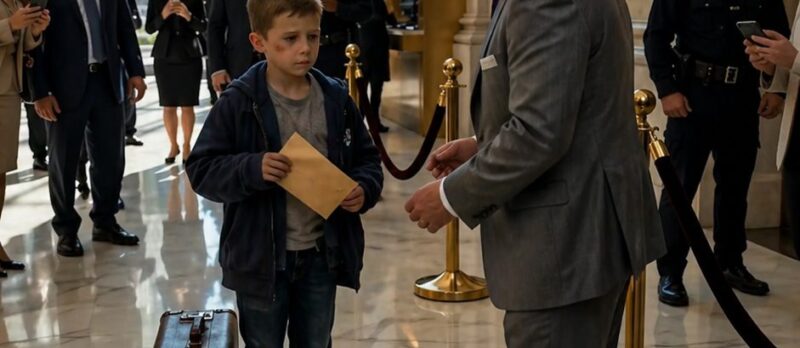
The teller covered her mouth. A guard reached instinctively for the letter.
The boy’s gaze never left the manager’s face.
And just before anyone could react, the lobby doors opened behind him.
A woman’s voice echoed in from the sunlight.
“Did he read it?”
The manager turned toward the entrance in terror.
For a moment, no one moved.
Then the crowd parted—slowly, instinctively—as if something heavier than authority was passing through them.
She didn’t rush.
She didn’t raise her voice.
She simply stepped into the light.
Older now. Pale. A faint scar traced along her jaw, disappearing beneath her collar. Her coat was simple, her posture steady—but her eyes… her eyes carried something that made the entire room feel smaller.
The boy turned first.
Relief flickered across his face—brief, quiet.
“She’s here,” he said.
The manager’s knees nearly gave way.
“You…” he whispered, stumbling back. “That’s impossible.”
But she kept walking.
Each step echoed across the marble, louder than the chaos had been moments earlier.
“Twenty years,” she said calmly. “And you still recognize me.”
No one spoke.
No one even moved to pick up the money anymore.
The guards hesitated, unsure whether they were witnessing a crime—or something far worse.
The manager shook his head, panic rising beneath his carefully controlled exterior.
“You died,” he said. “The reports—the fire—”
“I survived,” she interrupted.
Her voice didn’t rise.
It didn’t need to.
“And you knew that was possible.”
A ripple spread through the room.
The boy stood quietly beside the suitcase, as if none of this surprised him.
The manager glanced at the guards, then toward the exits—calculating, trapped.
“That fire…” he began, forcing steadiness into his voice. “It was an accident. Everyone knows that.”
“No,” she said.
One word.
Sharp. Final.
“You locked the door.”
The room fell into a silence unlike before—heavier, sharper—as if something had just crossed the line from suspicion into undeniable truth.
The manager let out a laugh, but it faltered midway.
“That’s ridiculous.”
She slipped her hand into her coat.
The guards stiffened instantly.
But she didn’t pull out a weapon.
Instead, she revealed a small, charred object.
A melted key.
A wave of gasps swept through the lobby.
“I kept this,” she said, raising it slightly. “The emergency exit key—the one that should have been on the wall… but wasn’t.”
The color drained from the manager’s face.
“You panicked,” she continued. “The investment collapsed. The numbers didn’t add up. An audit was coming.” Her eyes locked onto his. “And I found out.”
The boy looked up at her, listening—like he had heard pieces of this before, but never so clearly.
“You told me we’d fix it,” she said. “Then you locked me inside and set the fire.”
A woman near the rope whispered, “Oh my God…”
The manager’s composure broke.
“That’s a lie!” he snapped, louder than he intended. “You have no proof—”
“I have more than proof.”
She gestured toward the suitcase.
“And so does he.”
All eyes turned to the boy.
He stepped forward again—small, but unwavering.
“My mom said this belongs to the bank,” he said. “But not to him.”
The manager’s breathing grew shallow.
“What is that?” one of the guards asked.
The woman answered.
“Money that went missing the night of the fire.”
The silence deepened.
“He moved it before everything burned,” she continued. “Insurance covered the rest. He walked away clean… and I was meant to disappear with it.”
The manager suddenly lunged forward.
“Stop talking!”
But the guards were quicker.
They grabbed him, forcing him back.
“Sir, calm down—”
“No! She’s lying—she’s—”
“Then explain the money,” the teller said, her voice trembling but firm.
The manager froze.
For the first time, he had no answer.
Nothing prepared.
Nothing rehearsed.
The boy looked up at him—not with anger, but certainty.
“She said you’d react like that,” he said quietly.
Then he raised something else.
A small recorder.
“I recorded everything.”
The manager’s expression collapsed entirely.
Outside, sirens began to wail.
Closer. Louder.
The woman exhaled slowly, as if releasing twenty years of weight in a single breath.
“I didn’t come for revenge,” she said. “I came for the truth.”
Moments later, the police burst through the doors.
Commands rang out. Movement surged. Hands were pulled behind backs.
This time, the manager didn’t resist.
He only stared at her as they led him away.
“I thought you were gone,” he whispered.
She met his gaze one last time.
“I was,” she said.
“Until I chose not to be.”
The doors closed behind him.
The tension dissolved.
People began speaking again—quietly, cautiously, as if sound itself needed permission.
The boy glanced down at the scattered money.
“Did I do it right?” he asked.
She smiled gently and knelt beside him.
“You did everything right.”
He hesitated.
“Are we… okay now?”
She brushed her hand over his hair.
“Now we begin again.”
Outside, the sunlight remained unchanged.
The city kept moving.
But inside the bank, something had finally been made right.
Not by power.
Not by wealth.
But by a truth that refused to stay buried—
Even after the fire.