The Twin Girls Who Called My Late Wife “Mom”
Before he turned thirty, Moisés Aranda had achieved everything most people only dreamed of.
He built a thriving business empire in Monterrey, accumulated wealth beyond imagination, and earned the respect of the city’s most powerful people. Yet none of his accomplishments could ease the pain of losing the woman he loved.
Three years earlier, his wife, Valeria, had died after a devastating illness.
Moisés spent fortunes on specialists, experimental treatments, and private clinics, desperately trying to save her. Nothing worked.
After her death, he lived among reminders of her presence. Her perfume still lingered in the closet. Her favorite coffee mug sat untouched beside the machine.
Her smiling photograph remained on the piano. Over time, grief stopped feeling like a temporary wound and became part of who he was.
Concerned for his emotional state, his therapist, Dr. Esteban Salazar, encouraged him to leave the city and revisit places connected to happier memories.
Following that advice, Moisés traveled to the lakeside cottage in Valle de Bravo—a place Valeria had always adored.
The moment he arrived, memories rushed back.
But something unexpected was waiting for him.
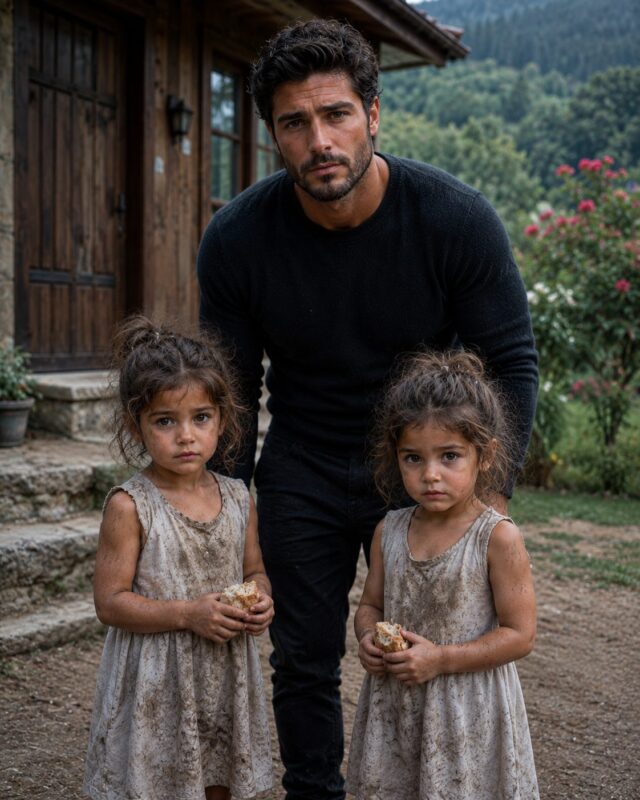
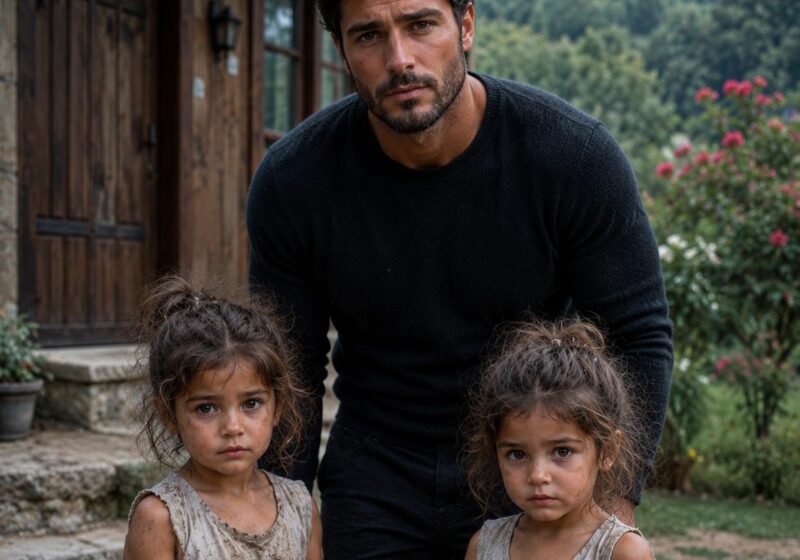
Standing outside the cottage were two identical little girls, no older than three years old. They were barefoot, wearing dirty dresses, and completely alone.
When he gently asked their names, they introduced themselves as Luli and Lola.
There was no sign of parents, no parked vehicles, and no explanation for how two toddlers had ended up in such an isolated place.
Unable to abandon them, Moisés brought them inside, fed them, and contacted local authorities. Unfortunately, due to the weekend, he was told that official assistance would not arrive until Monday.
As the hours passed, the girls slowly began to trust him.
That evening, while helping them bathe, Luli unexpectedly splashed water into his face.
For a moment, Moisés stood frozen.
Then something happened that had not occurred since Valeria’s death.
He laughed.
A genuine laugh.
The sound felt unfamiliar, almost forgotten.
Moments later, however, the atmosphere changed.
Lola pointed toward a framed photograph resting on the bathroom counter—a picture of Valeria.
Then she softly whispered a single word.
“Mommy.”
The word sent a chill through Moisés.
Valeria had never had children.
Yet somehow these little girls seemed connected to her.
Later that night, the mystery deepened. Lola quietly hummed a simple melody that Valeria had invented years earlier during a private moment between them. No one else should have known it.
The coincidence was impossible to explain.
The following day brought even stranger revelations.
Lola spoke about a “cold place,” doctors dressed in white coats, injections, and a sick mother. She drew pictures of a woman with long hair, a house, and a large twisted tree.
Pointing to the roots of the tree in her drawing, she said:
“Mama’s box.”
The description stunned Moisés.
Behind the cottage stood an old twisted tree. Years earlier, he had secretly buried a small white baby blanket beneath it—a blanket Valeria had purchased while dreaming about becoming a mother.
No one knew it was there.
Driven by a mixture of fear and curiosity, Moisés dug beneath the tree.
He found the buried box.
Inside lay the blanket exactly where he had left it.
But there was something else.
A hospital identification bracelet.
He had never seen it before.
The bracelet was labeled:
Baby A. Aranda
And it was dated one day before Valeria’s reported death.
The discovery shattered everything he thought he knew.
Back inside the cottage, Moisés noticed small matching scars on the girls’ wrists—old marks left by medical needles.
As he held them close, one certainty settled in his mind.
These children were connected to Valeria.
And he would uncover the truth no matter the cost.
That evening, a powerful storm swept across the region. As the electricity failed and darkness filled the cottage, Lola casually mentioned someone she called “Doctor Star,” a man who gave people injections that made them sleep.
Not long afterward, Moisés received a call from a blocked number.
The voice on the other end froze him in place.
It was Valeria.
Alive.
With trembling words, she revealed a nightmare beyond anything he could have imagined.
According to Valeria, she had never died.
Instead, she had become trapped within a secret medical operation that targeted wealthy families. The organization conducted illegal experiments involving fertility treatments, genetic manipulation, and stolen embryos.
Even more shocking, she claimed that Dr. Esteban Salazar had been deeply involved.
The twins, she explained, were their daughters.
She had been told her babies died.
Moisés had been told that Valeria died.
Both had been deceived.
Before ending the call, Valeria warned him not to trust Salazar and instructed him to search inside a hidden compartment within the cottage piano.
There, Moisés discovered evidence that changed everything.
A ledger.
Confidential files.
A flash drive.
And a photograph of Valeria holding two newborn girls.
Written on the back were four heartbreaking words:
Luli and Lola. Tell their father.
Only minutes later, Dr. Salazar arrived at the cottage.
Realizing he was in danger, Moisés hid the twins and prepared to escape.
Soon armed men forced their way inside.
Carrying the girls, he fled through the rear of the property into the storm.
Near the old tree, a figure emerged from the darkness.
It was Valeria.
Older.
Scarred.
Exhausted.
But alive.
Their reunion lasted only moments before Salazar and his men surrounded them.
What Salazar did not know was that Valeria had already been working secretly with federal investigators. The twins had become part of a carefully planned operation designed to expose the criminal network.
Police units arrived.
A violent confrontation erupted.
During the chaos, Salazar seized Valeria and held her hostage. She fought back bravely, but a gunshot suddenly echoed through the storm.
Valeria collapsed.
Moments later, federal agents overpowered Salazar and placed him under arrest.
By sunrise, investigators confirmed that the clinic had operated an international criminal enterprise involving illegal medical experimentation, stolen embryos, falsified identities, and fabricated death records.
DNA testing later proved what Moisés already felt in his heart.
Luli and Lola were his daughters.
Valeria survived long enough to reveal the truth.
But as investigators dug deeper into the evidence, they uncovered something even darker than anyone had imagined.
The deeper the investigators dug, the more horrifying the truth became.
The evidence suggested that Valeria was far from the only victim.
Hidden among thousands of classified files were records indicating that dozens of patients had been falsely declared dead.
Officially, they no longer existed. In reality, they had been secretly transferred, monitored, and used as part of a long-running operation concealed behind fabricated medical reports and falsified death certificates.
For years, entire families had mourned loved ones who were never truly gone.
As federal agents sorted through the seized documents, one photograph caught Moisés’s attention.
It had been taken only a few months earlier.
In the image, Valeria stood outdoors beneath a canopy of trees, her arm wrapped protectively around the shoulders of a young boy he had never seen before.
The child appeared to be around eight years old.
There was something unusual in his eyes—a sadness that seemed far older than his age.
Moisés stared at the photograph.
“Who is he?” he whispered.
No file attached to the image provided an answer.
Later, while reviewing the evidence at the cottage, he showed the picture to the twins.
The reaction was immediate.
The moment Lola saw the boy, her eyes widened.
“Mateo,” she said softly.
Moisés leaned forward.
“You know him?”
Lola nodded.
For a few seconds, she seemed lost in thought, as though searching through memories she did not fully understand.
Then she spoke again.
The words sent a chill through the room.
“Mama said he is the one they made first.”
Silence followed.
Every investigator nearby turned toward her.
“The first?” Moisés asked carefully.
Lola nodded once more.
“He was there before us.”
No one knew exactly what she meant.
But judging by the expressions on the faces of the federal agents, they feared they did.
If the twins had been part of an illegal experiment involving fertility treatments, genetic manipulation, and stolen embryos, then Mateo might represent something even more significant.
Not another victim.
The beginning.
The first successful subject.
The first child created through whatever secret process the organization had been hiding for years.
As dawn spread across Valle de Bravo, golden light filtered through the cottage windows, illuminating stacks of evidence and unanswered questions.
Salazar was in custody.
The criminal network had been exposed.
Luli and Lola had finally been identified.
Yet instead of ending, the mystery seemed to be growing larger.
Then Moisés’s phone suddenly began to ring.
Everyone in the room froze.
He slowly reached for the device.
The screen displayed an incoming call.
No number.
No location.
Only a name.
VALERIA ARANDA.
For several long seconds, nobody spoke.
Valeria was supposed to be under federal protection.
She was not supposed to have access to a phone.
And she certainly was not supposed to be calling him.
With his heart pounding, Moisés pressed the answer button.
“Valeria?”
The line crackled softly.
Then a woman’s trembling voice whispered:
“Moisés… listen carefully. They found Mateo.”
A pause.
And then the words that changed everything once again:
“They know we’re still alive.”