“Why He Couldn’t Say It”
For a long, suspended moment, she forgot how to breathe.
Not because he was crying—
but because of his hand.
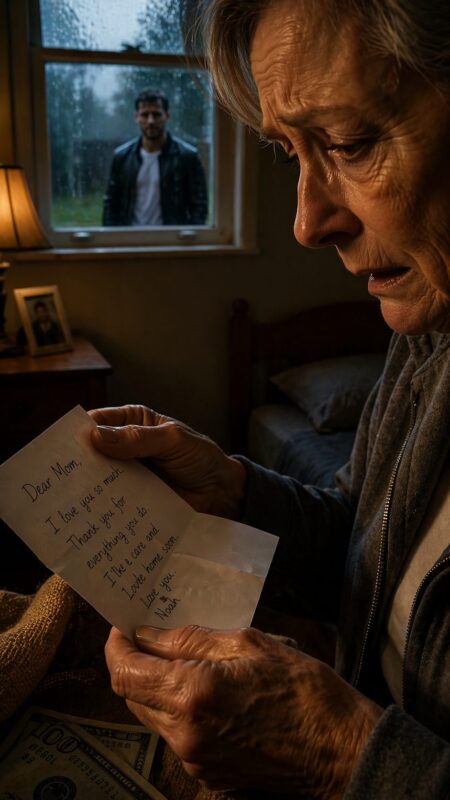
The missing ring told her everything before the letter could.
With blurred vision, she lowered her gaze back to the page and continued reading.
Her son’s handwriting was uneven—pressed deeply into the paper in some places, faint in others—as if he had paused again and again, struggling to find the strength to finish.
“She made me choose.”
The words struck her heavily.
The young woman at the gate hadn’t simply been watching.
She had been judging.
For months—perhaps even years—she had complained about the money he spent helping his mother: small bags of groceries, medicine, rent when times were hard.
Every act of care became an argument. Every visit turned into a conflict. Every kindness was labeled weakness.
Then came the ultimatum:
her or his mother.
He chose neither.
Not entirely.
Instead, he sold the ring.
That was the source of the money.
Not business.
Not luck.
Not savings.
But the last valuable thing that still truly belonged to him.
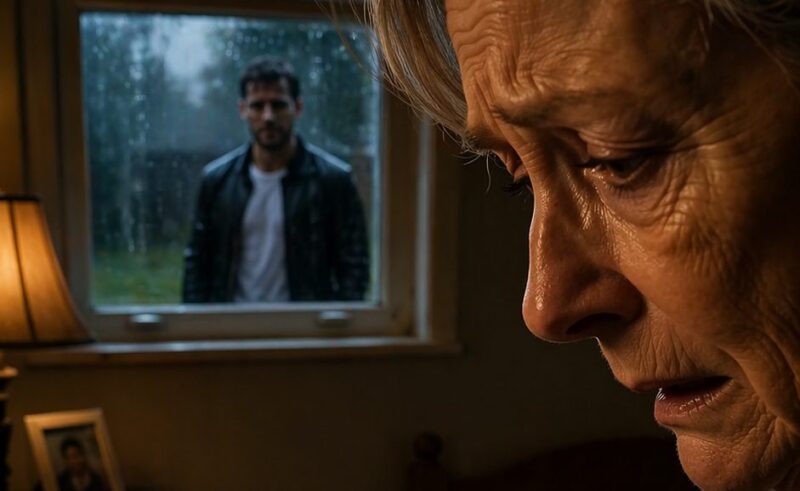
The mother glanced again through the rain-streaked window, but he was gone.
Only the trembling gate remained.
She returned to the letter and read the final lines:
“You fed me when you had nothing.
You covered me when you had no warmth.
I won’t let you grow old in hunger while I live under a roof.
Forgive me for making it look harsh.”
That was what broke her.
Not the money.
Not the apology.
But that final sentence.
Because it explained everything.
The rough push.
The cold tone.
The way he couldn’t meet her eyes.
He had made himself seem cruel so the woman in the doorway wouldn’t see the truth.
He had chosen to appear heartless in front of one person
so he could still remain a son in his own conscience.
The mother pressed the letter to her chest and wept the way only mothers do—softly at first, then with the deep ache of understanding too much all at once.
He had never stopped loving her.
He had simply hidden that love inside humiliation, because it was the only way he could still give it.
Then she noticed something else inside the envelope.
A small key.
Taped carefully to the fold of the letter.
And beneath it, one final line:
“If I don’t come back, the locker is yours.
I put everything there before she could take it.”
In that moment, her sorrow turned into fear.
Because this was no longer just a son caught between his wife and his mother.
This was a man preparing for a battle within his own life.
And the sack of “rice” had not been an act of charity.
It had been a farewell, disguised as shame.