I was twelve hours into a shift at the grocery store—exhausted and preoccupied with how I’d manage to cover my sister Dana’s medical expenses—
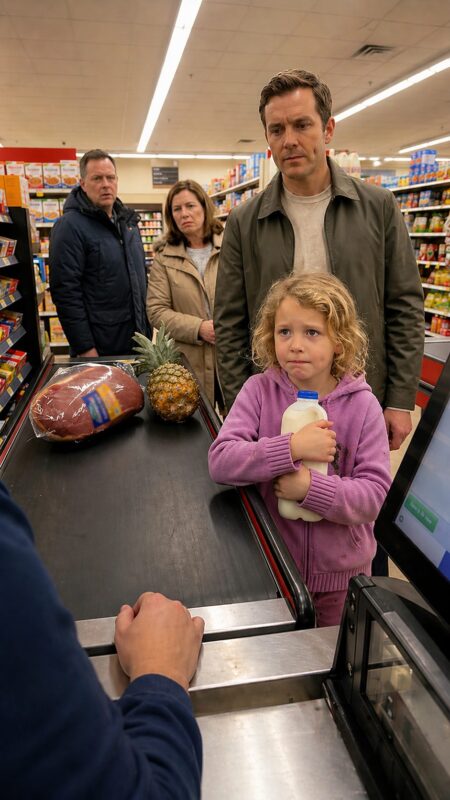
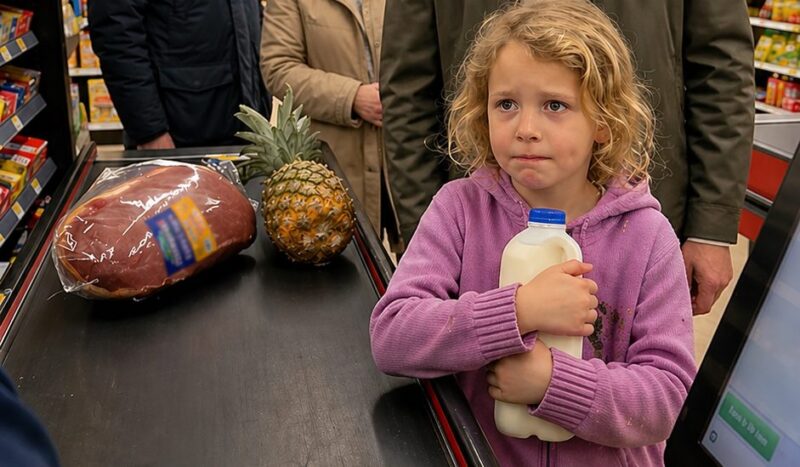
when an eight-year-old girl stepped up to my register, clutching a single bottle of milk.
In a barely audible voice, she asked if she could pay for it the next day. I thought refusing her would be the hardest moment of my shift. I was mistaken.
At forty-one, my life had narrowed into a relentless routine: long hours, mounting hospital bills, and constant anxiety.
Our parents were gone, and there was no backup plan—just me, trying to keep Dana alive one paycheck at a time.
That day, like so many others, the math didn’t work in my favor. I was coming up short again.
The girl looked delicate, yet there was a quiet strength about her that no child should have to carry.
Her sweater was worn thin, her hands reddened by the cold, and her eyes held a calm determination.
When I told her I couldn’t allow her to pay later, she explained that her twin brother was sick and crying, and their mother, Marilyn, would be paid the next day.
There was something so sincere in her voice that it made turning her away even harder.
Customers behind her began to sigh impatiently, but one man stood out. He wasn’t irritated—he was watching her closely, almost as if something about her unsettled him.
I asked my manager to cover my register, gathered a few essentials—bread, soup, fruit, medicine, and another bottle of milk—and paid for everything myself.
When I handed her the bags, she was overcome with gratitude and hurried away.
The man stepped up next, distracted and pale. He bought nothing more than a pack of gum before quickly leaving in the same direction.
That night, after checking on Dana and reassuring her she wasn’t a burden, I couldn’t shake the image of that girl—or the man’s reaction.
The following afternoon, I found him waiting outside the store. He introduced himself as Daniel and asked me not to leave just yet.
He told me that when the girl mentioned her mother’s name—Marilyn—it triggered something. Marilyn had once been the love of his life.
Years ago, under pressure from his wealthy family, he walked away from her. Seeing the girl—who bore a striking resemblance to him—sparked suspicion.
He followed her home and uncovered the truth: Marilyn had twins, a boy and a girl, and had never told him.
His actions made me uneasy, but I couldn’t ignore what I had witnessed the night before—the girl’s desperation, the illness she described.
Daniel admitted that Marilyn and the children were indeed sick and asked for my help, saying Marilyn would trust me more than she would ever trust him.
Reluctantly, I agreed and went with him.
Their home was small and worn, but clean—a clear sign Marilyn was doing everything she could to hold things together.
The children, Lucy and Ben, were visibly ill, and Marilyn looked even worse.
The moment she saw Daniel, her reaction was immediate—anger mixed with deep hurt.
Old wounds surfaced instantly, and their argument filled the room. I stepped in, trying to redirect the focus to what truly mattered: they needed medical attention.
Daniel had already arranged for a private doctor. Lucy and Ben had the flu, and Marilyn was on the verge of pneumonia.
At first, she resisted any help, but I urged her to think of her children. That finally broke through.
Over the next week, Daniel took care of everything—medical bills, medication, groceries, even support at home.
But money couldn’t repair the emotional distance. He tried to step into a father’s role, but to the children, he was still a stranger. I told him plainly—he would have to earn that place.
Meanwhile, my own situation continued to deteriorate.
Dana’s treatment was delayed because of insurance complications, and financially, I was slipping further behind.
When Daniel noticed the strain, I tried to brush it off, but he didn’t let it go. Eventually, I told him the truth.
He offered to help—framing it not as charity, but as repayment for what I had done for his children. I resisted at first.
I didn’t want to be someone who needed saving. But I was exhausted from pretending I had everything under control.
The next day, he was waiting for me after my shift—ready to help.
For the first time in a long while, I allowed myself to believe that maybe things could change—not just for Marilyn and her children, but for Dana as well.