I had barely finished signing the final divorce papers when my former mother-in-law, Eleanor, gave me a smug smile.
“You have twenty-four hours to get out of my house.”
My ex-husband Julian sat silently beside her while his sister laughed. I didn’t argue.
Instead, I went upstairs, opened the safe behind my bookshelf, and removed a red-bound folder and an encrypted hard drive.
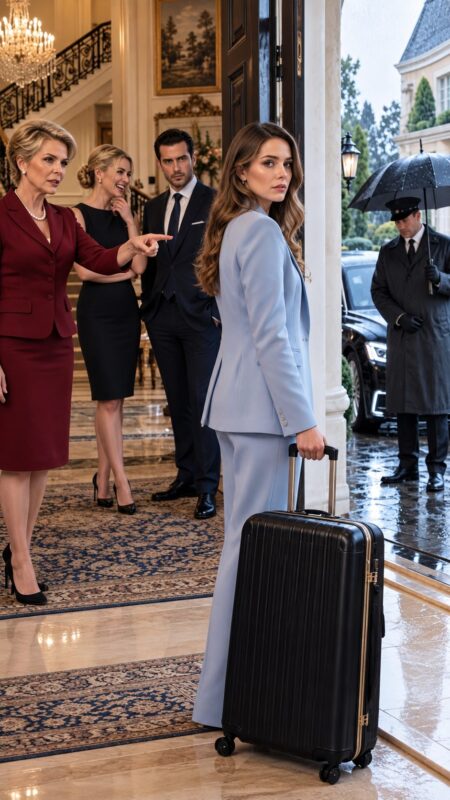
An hour later, Eleanor demanded to inspect my suitcase. Inside were clothes, my laptop, my grandmother’s photograph, and the folder.
She mocked me, assuming it contained sentimental memories.
“You’re partly right,” I said. “They’re just not the kind written with tears.”
When Julian appeared, I told him that from now on he should call me Miss Sutton—especially around the press. His face went pale.
Then a black sedan arrived. The driver announced that Arthur Vance’s car was waiting for me.
Arthur owned ten percent of Vanguard Architects and was powerful enough to make Eleanor nervous.
Before leaving, I told her, “You’ll understand tomorrow.”
The next morning, I sat with Arthur on the forty-second floor of a downtown office tower and opened the folder.
It contained twelve years of contracts, financing records, shareholder agreements, and one crucial partnership agreement.
Years earlier, Vanguard had nearly collapsed under debt.
I had found investors, renegotiated contracts, restructured deals, and ultimately brought Arthur into the company.
His condition had been simple: he wasn’t investing only in Julian. He was investing in me.
The agreement revealed that I was managing partner of Sutton-Vance Holdings, which owned thirty-one percent of Vanguard.
Arthur owned forty-nine percent of Sutton-Vance.
I owned fifty-one.
For eleven years, I had quietly controlled Vanguard’s largest outside shareholder.
That morning, our attorneys issued formal notices and called an emergency board meeting. Julian and Eleanor flooded my phone with calls.
At Vanguard headquarters, Eleanor angrily demanded to know what I had done.
“Nothing you didn’t authorize eleven years ago.”
Arthur handed her the agreement. Her expression changed when she saw my ownership.
She accused me of wanting revenge.
“No. I’m going to stop protecting people who never valued the protection.”
I explained that relationships I had built accounted for nearly forty percent of Vanguard’s institutional business.

I could have turned the divorce into a public war, but hundreds of innocent employees depended on the company.
“I’m not destroying Vanguard,” I said. “I’m restructuring it.”
An independent review had uncovered governance problems, and the board removed Eleanor from leadership. No one defended her—not even Julian.
After she left, Julian admitted something unexpected: he had never wanted to run Vanguard. He wanted to design buildings, but Eleanor had pushed him into management.
There was no reconciliation between us. Some things shouldn’t be repaired simply because someone finally realizes how badly they broke them.
But I gave Julian a choice.
He left executive management and returned to architecture.
Three months later, Vanguard had an independent CEO.
Julian ran a design studio within the firm, Eleanor disappeared from daily operations, and I became chairwoman of Sutton-Vance Holdings.
Six months later, Arthur showed me an old photograph.
Standing beside a younger Arthur was my grandmother.
She had given him his first real investment decades earlier.
When I approached Arthur eleven years ago, he had recognized my surname immediately but said
nothing because he wanted to know whether I deserved his investment on my own ability.
My grandmother’s small investment had also remained with Arthur, growing over the decades. Behind the original certificate was a handwritten note from her:
“When someone mistakes your kindness for weakness, don’t become cruel. Become impossible to underestimate.”
I finally understood that I hadn’t walked away from Eleanor’s mansion carrying only a suitcase.
I had carried a legacy.
A year later, Sutton-Vance created a program supporting talented young architects without connections. The first scholarship was named after my grandmother.
At the ceremony, Eleanor appeared quietly in the back row.
Afterward, she approached me.
“I was wrong about you.”
“I know.”
Then she hesitated.
“I’m sorry.”
I nodded—not because the past had disappeared, but because I no longer needed her approval to know my worth.
Walking out of that mansion had cost me a controlling family, a broken marriage, and a life where I had made myself smaller for others.
What I gained was worth far more:
My name.
My future.
And the realization that sometimes being thrown out isn’t the end of your story.
Sometimes it’s the first time the door is finally open.