I Raised My Late Fiancée’s Six Children After She Disappeared—Ten Years Later, Her Eldest Son Looked Me in the Eye and Said, “Dad, I Think You Deserve to Know the Truth About Mom”
When Claire vanished without warning, everyone assumed I would eventually leave, move on, and rebuild my life. Instead, I stayed.
I raised her six children as my own.
For a decade, I became their constant presence—the driver, the cook, the protector, the only father figure they ever truly relied on—holding onto the belief that someday we might finally understand what happened to her.
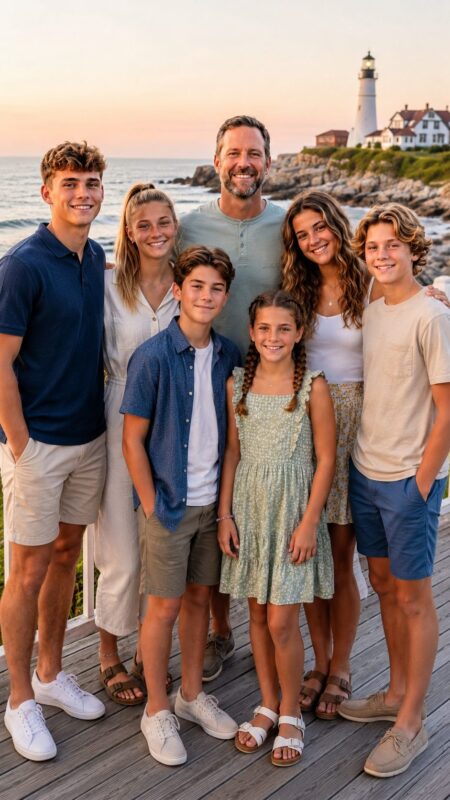
It all started on a quiet summer afternoon at Pelican Cove. Claire and I had taken the kids for one last weekend together before school resumed.
I stepped away briefly to grab drinks and fries. Twelve minutes later, I returned to find her towel neatly folded, her sunglasses resting on top of a book—and Claire gone.
At first, I assumed she had gone for a swim. Then I noticed Noah, her oldest son, standing perfectly still at the water’s edge, staring out at the sea.
By nightfall, search teams filled the beach. By midnight, officials were speaking of drowning. After four days of exhaustive searches and no sign of her, Claire was declared lost to the ocean.
I was twenty-nine, not married, with no legal responsibility toward her children.
Everyone expected me to walk away. But at her memorial service—watching six confused, broken children sitting silently in a church—I made my decision. I stayed.
I sold my truck when money got tight. I worked double shifts. I learned how to braid hair, prepare six breakfasts before sunrise, sign school documents, and sit through night terrors I never knew how to fix.
I became whatever they needed me to be. The youngest eventually started calling me “Dad” without hesitation.
Noah, however, never made it easy—always observant, always guarded—but over time, even he accepted me.
Years passed. The children grew. Noah left for college.
Then, one Friday, he came home and found me under the kitchen sink fixing a leak—and said something that shattered the fragile peace I had built.
He told me that during a trip to Cresthollow, he had seen a woman who looked exactly like Claire.
At first, I dismissed it as grief playing tricks on memory.
But he didn’t back down. He showed me a blurred photograph and a short video: a woman laughing beside an unfamiliar man, wearing a sun hat and a loose summer dress—someone who looked undeniably like Claire. Alive.
The next morning, we drove to Cresthollow.
At a coastal resort, the manager, Diane, reviewed security footage. She confirmed what Noah had claimed: Claire had been there. Walking. Laughing. Living.
What began as disbelief quickly turned into anger—ten years of mourning while she, supposedly, had been building another life.
We followed every lead through small shops along the coast until an elderly woman in a seashell store recognized her immediately. She even provided a delivery address.
The trail led us to a quiet yellow bungalow by the sea.
When we knocked, the door opened to a woman who looked exactly like Claire.
But she didn’t recognize us.
No shock. No reaction. No memory at all—only confusion.
Her husband stepped forward, cautious and protective. When Noah showed them the images, the woman studied them in silence before inviting us inside.
Her name was Matilda.
And then she told us the truth.
She was Claire’s twin sister—separated in foster care as an infant. Raised in different homes, they had lived entirely separate lives, unaware of each other for years.
Claire had once searched for her origins as well.
Old foster records—ones I had never fully understood at the time—now revealed mention of a biological sibling. Matilda had also spent years searching, until every lead went cold.
The resemblance wasn’t deception. It wasn’t betrayal.
It was blood.
A DNA test later confirmed it: Matilda was Claire’s twin sister.
The woman Noah had seen was not his mother returned from the dead—but her reflection, living an entirely different life.
What followed was a grief that changed shape—no longer simple loss, but something far more complicated: sorrow mixed with an unexpected connection.
When we returned home, we told the children everything.
It was emotional, painful, and difficult to process. But in time, Matilda became part of our lives. The youngest child ran to her without hesitation, as though recognizing something familiar in her presence.
She did not replace Claire.
But she became a living thread that still connected us to her.
Claire never came back. The world still calls her lost.
And in many ways, she remains so.
But she left something behind—her children, her memory, and a sister I never knew existed.
And sometimes, in the silence of the night, I still find myself listening for a door that will never open again.