I sold my house six months ago, but my son, Greg, had no idea.
Yesterday, he placed my suitcase beside the front door and said, “A nursing home has a bed for you, Mom. Sign the house over and leave by Friday.”
I took a sip of tea. “First ask the man who owns this house.”
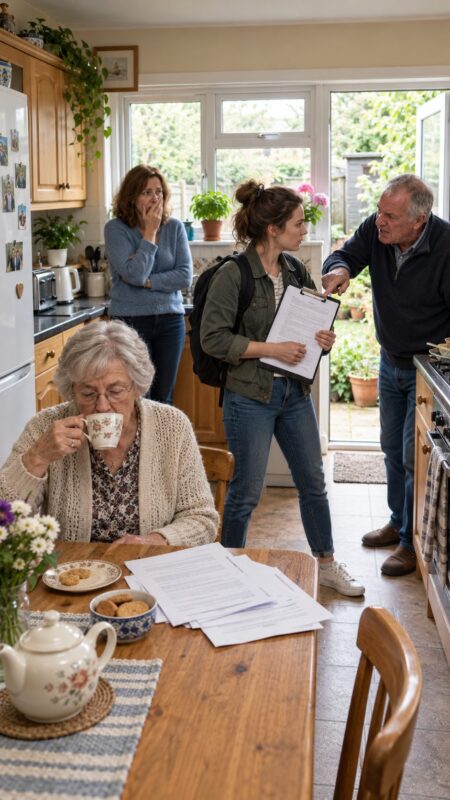
Greg laughed. “The only man who ever owned it was buried two years ago.”
He meant his father, Walter.
Walter had built the house himself in 1974. Three days after his funeral, Greg and his wife, Dana, arrived with a moving truck.
“You shouldn’t be alone, Mom,” Greg had said.
By the end of the month, they were sleeping in my bedroom while I slept on a folding bed in the sewing room.
Dana began calling it “our house,” and Greg started taking three hundred dollars from my pension every month.
“Everyone pays their share,” he insisted.
One night, I overheard him speaking on the phone.
“She’s eighty-one,” he said. “The house is worth four hundred thousand, easy. We’ll list it the day she’s out.”
His laughter hurt more than his words. By morning, I had made my decision.
While Greg was at work and Dana was away, I took the deed, my checkbook, and Walter’s leather folder to a lawyer.
That afternoon, I sold the house to my granddaughter, Emily—the daughter Greg had abandoned after marrying Dana.
The sale was completely legal, recorded at the county office, and included a lease allowing me to live there for the rest of my life for one dollar a year.
Emily bought the property with money from Walter’s life-insurance policy, which he had left to her.
I hid my copy of the deed in the flour tin, certain Greg and Dana would never look there. For six months, I watched them prepare to sell a house they no longer owned.
Dana picked paint colors, and Greg even brought in a realtor named Chuck.

“The old lady comes with the house for now,” Greg joked. “But not for long.”
Then came the suitcase and nursing-home paperwork.
On Friday morning, Greg dressed for the realtor’s visit, while Dana arranged cookies on Walter’s china. The transfer papers waited on the table.
At ten o’clock, the doorbell rang.
Greg opened the door—and froze.
Emily stood there holding a blue folder and a ring of keys.
“Hello, Dad.”
Dana stared at her. “Who is this?”
“Nobody,” Greg said quickly.
Emily stepped inside. “That’s strange, because I have the keys to this house.”
She was the granddaughter Greg had claimed had disappeared. In reality, Emily had sent me birthday cards for years and had quietly stayed in contact.
When I asked her to buy the house, she agreed immediately.
Greg grabbed the folder and read the deed.
“Emily Rose Carter,” he whispered.
Dana scanned the document. “You sold it?”
“I sold it six months ago,” I replied.
Greg insisted I had been confused, but Emily explained that the transfer had been witnessed, recorded, and legally valid. Then she revealed the purchase price: one dollar.
“I sold it to someone I trusted,” I said.
Emily also showed them Walter’s letter.
He had written that she had never abandoned the family and had left her his insurance money to build a life nobody could take from her—and to protect me, even from his own son.
Greg shouted that the money should have been his.
“It was never yours,” I told him.
The lawyer then entered and served Greg and Dana with formal notice. They had no ownership rights and had to remove their belongings by five o’clock—the same deadline Greg had given me.
When Greg begged me to reconsider, I pointed to the suitcase.
“You chose the nursing home. You circled the bed number. You meant every word.”
Emily played a recording of Greg discussing the house sale. His own voice filled the room, followed by Dana’s laughter. After that, neither could argue.
I told them to leave. By five, their truck was gone.
Before departing, Greg tried to take Walter’s toolbox, but I stopped him. It belonged to Emily. Inside, we found an old photograph of Walter standing in front of the house.
On the back he had written, “Someday, this house will belong to the person who understands what it cost to build.”
Emily later transferred the property back to me as a gift. She also used the remaining insurance money to create the Walter Hart Home Protection Fund for elderly people pressured out of their homes.
Three weeks later, Greg messaged, “Can I come home?”
I replied, “You can visit when you understand the difference between coming home and coming back for what you think belongs to you.”
He never answered.
Now Emily and I sit on Walter’s porch every Sunday morning. The house is mine again, the family is smaller, and for the first time in years, it is honest.