My mother-in-law booked an extravagant party at my restaurant and left without paying.
I accepted the loss to keep peace in the family, but days later she returned with forty wealthy friends and acted as though she owned the place.
Evelyn stood during dinner and raised her glass.
“I practically own this restaurant,” she announced. “My daughter-in-law Claire is just the servant who makes everything perfect.”
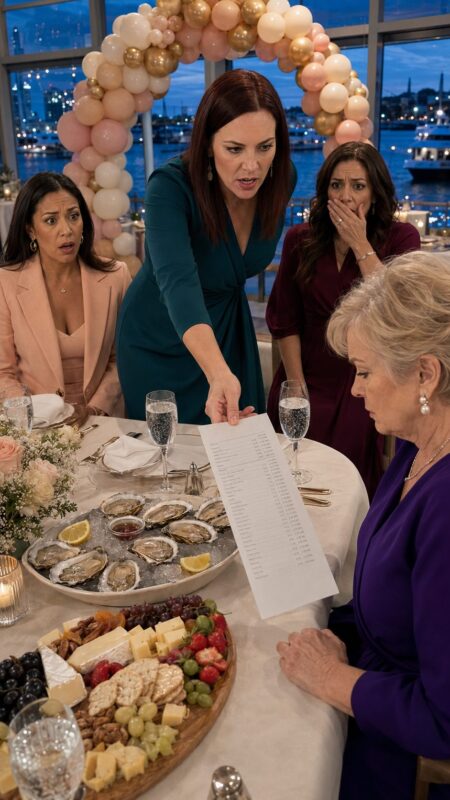
Everyone laughed. I said nothing. Instead, I went to my office, printed an invoice, and placed it beside her glass.
“Since you practically own the place,” I said, “you won’t mind paying the $48,000 you owe.”
Her smile vanished.
The bill covered that evening’s $26,000 dinner and the unpaid $22,000 celebration from the previous week.
“Family doesn’t invoice family,” Evelyn protested.
“Restaurants invoice customers,” I replied.
She claimed I owed everything to her son, Ethan. Before I could answer, he appeared in the doorway.
“She built this restaurant before she met me,” he admitted.
For a moment, I thought he would defend me. Instead, he asked me not to embarrass his mother because she had only been joking.
“She called your wife a servant in front of forty people,” I said. “Why are you worried about her embarrassment?”
When Evelyn ordered Ethan to “handle” me, he hesitated. That hesitation told me everything.
I called my general manager, Maya, who brought out the agreement Evelyn had signed electronically.
It included her payment guarantee, identification, and credit card—which had already been declined.
Evelyn tried to leave, but Maya explained that although nobody was being detained,
formal collection proceedings would begin the next morning if the debt remained unpaid.
Her friends started distancing themselves from her.
Then Charles, a real estate developer, noticed that Evelyn had ordered twelve expensive bottles, although only four had been opened.
Maya revealed that Evelyn wanted the other eight loaded into her car.
A guest inspected the gift bags near the entrance and discovered restaurant linens, unopened bottles, and imported caviar.

Evelyn had planned not only to avoid payment but also to take thousands of dollars’ worth of products.
Margaret Hale, chairwoman of a major charitable foundation Evelyn hoped to join, stood up.
“Is this how you fund your generosity?” she asked.
Margaret explained that Evelyn had promised a large donation to a waterfront food program and falsely claimed the dinner was being hosted in partnership with my restaurant.
She immediately withdrew Evelyn’s board application.
Evelyn begged Ethan to defend her, but he finally refused.
“You signed the contract,” he said. “You pay the bill.”
Margaret then placed a $50,000 check before me.
It had been intended as part of Evelyn’s supposed donation, but Evelyn had never contributed anything.
Margaret proposed using the money to create a restaurant-training program for young adults leaving foster care.
I accepted on the condition that every dollar go directly toward training, while Harbor & Hearth provided meals, mentorship, and paid work placements.
Six months later, photographs of the program’s first twelve graduates decorated our private dining room. Nine had permanent jobs, and three worked at my restaurant.
Ethan and I were living separately while he attended counseling and learned to stop excusing his mother. Whether our marriage survived would depend on his actions.
Evelyn eventually paid the entire bill, returned the unopened products, and sold her diamond bracelet.
On the program’s opening night, I received her pearl necklace with a note asking me to sell it and sponsor another student.
Then I noticed Evelyn standing quietly near the entrance. She placed an application on the registration table.
Under “Position Requested,” she had written: “Volunteer dishwasher.”
I could have rejected her. Instead, I handed her an apron.
The best revenge was never humiliating the woman who called me a servant. It was teaching her that serving others was nothing to be ashamed of.
That night, Evelyn worked in my restaurant—and finally earned her place there.
Would you have given Evelyn a second chance, or told her it was already too late?