My eight-year-old son, Noah, gave up his lunch money to buy a red dress for Lucy, our neighbor’s two-year-old daughter, who had Down syndrome.
The next morning, our lawn was covered with lunchboxes—but what Noah discovered inside the largest one made him turn pale.
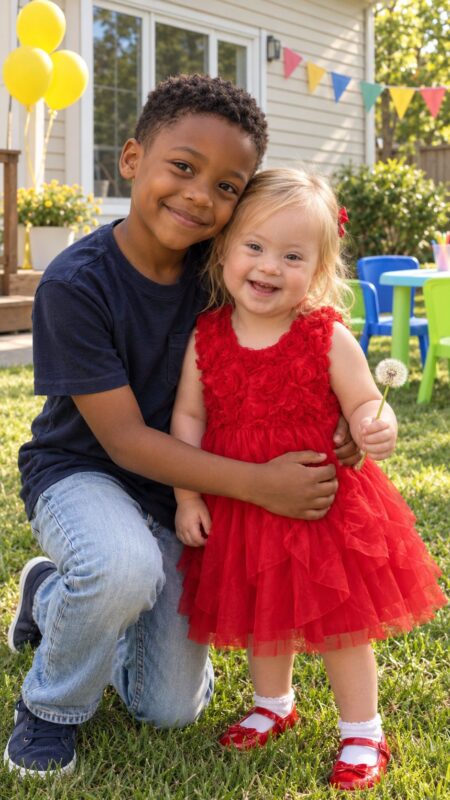
Noah adored Lucy. He often drew pictures beside her stroller, brought her dandelions, and made her laugh.
A month before her birthday, he noticed a tiny red dress in a store window.
“Mom, Lucy would look like a princess in that.”
I explained that Lucy’s mother, Hannah, couldn’t afford a birthday celebration because all her money went toward Lucy’s developmental activities.
Noah began refusing treats and doing small jobs for neighbors. Unknown to me, he also stopped buying school lunches and saved every dollar.
Eventually, he bought the dress.
When my mother-in-law learned what he had done, she laughed.
“You skipped lunch for that? Lucy doesn’t even understand birthdays.”
Noah’s smile disappeared.
“She knows when someone’s kind to her.”
At Lucy’s backyard party, Hannah helped her put on the dress. Lucy squealed, grabbed the skirt, and twirled excitedly. Noah’s happiness filled the entire yard.
The following morning, he ran into my bedroom.
“Mom! Come outside!”
Nearly fifty lunchboxes covered our lawn. In the center sat a battered metal one with a note taped to it:
Open this one first.
Noah lifted the lid and froze. Inside were bundles of cash and a faded photograph of two girls. One was my mother-in-law as a child; the other wore a red dress.
Across the photograph were the words:
For the kindness I was too afraid to show.
“Call the police,” Noah whispered.
Two officers arrived and counted $24,000. Beneath the money was a withdrawal receipt bearing my mother-in-law’s name.
She arrived minutes later. When she saw the lunchbox and photograph, she began crying.
“The money is mine,” she admitted.

The girl in the photograph was her younger sister, Rose, who had Down syndrome. Their parents had hidden Rose from visitors and eventually sent her to an institution.
Rose had once wanted a red dress.
My mother-in-law had started saving her lunch money to buy it, but when classmates mocked her, she became ashamed.
She threw away her savings and denied that Rose was her sister.
“Rose died before I apologized,” she said.
Then she turned to Noah.
“I laughed yesterday because you did what I was too frightened to do. You made me remember my failure.”
Unable to sleep after Lucy’s party, she had withdrawn the money she intended to leave her grandchildren. She now wanted it used for Lucy’s care.
However, she hadn’t brought the other lunchboxes.
A school bus suddenly stopped outside. Noah’s teacher stepped down, followed by his classmates and several parents.
After hearing that Noah had skipped lunch to buy Lucy’s dress, they decided he should never miss another meal because of his kindness.
Each lunchbox contained snacks, coins, or notes. One read:
You shared your lunch with Lucy without her knowing. Now we’re sharing ours with you.
Then Hannah arrived carrying Lucy, who was still wearing the red dress. Seeing Noah, Lucy squealed his name and reached toward him.
My mother-in-law approached Hannah.
“My sister was named Rose. I spent years pretending her story didn’t exist. If you’ll let me, I want to help Lucy—and tell people why.”
Three months later, the money established the Rose Project, providing developmental activities, birthday celebrations, and family support for children with disabilities.
At its opening ceremony, my mother-in-law gave Noah the restored metal lunchbox. Inside was a plaque:
NOAH’S BOX
One child’s courage opened what an entire family had kept closed for fifty years.
She also revealed that Noah would someday help guide the project.
“I don’t need my name on it,” Noah said. “Put Lucy’s beside Rose’s. She’s why I saved the money.”
The organization became the Rose and Lucy Project. The lunchbox now stands at its entrance beside photographs of Rose and Lucy in red dresses.
Below them are Noah’s words:
People may forget what you bought for them, but they will never forget when you made them feel worth celebrating.