As the neighborhood slipped into a tense midnight silence, twelve bikers showed up at our door asking for my daughter—and what they revealed forced me to face a truth far more frightening than anything outside.
I’ve worked on enough real-life accounts—stories drawn from police reports, interviews, unfinished testimonies, and the quiet gaps between what people say and what they choose to hide—
to understand that the most disturbing truths rarely arrive with force. They don’t crash through doors or shatter windows.
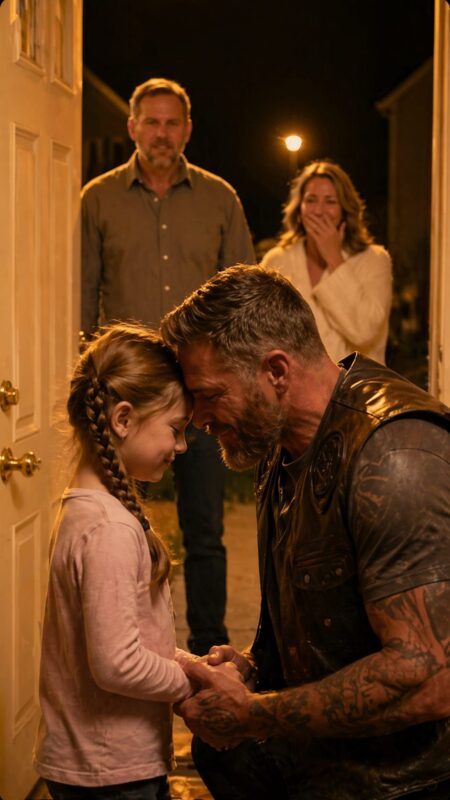
They emerge quietly, wrapped in routine, in familiar voices, in the kind of life you’ve already convinced yourself is safe.
And when they finally surface, what makes them unbearable isn’t just what they expose—it’s the realization that part of you already knew, long before you allowed yourself to admit it. This is one of those stories.
And to tell it honestly, I can’t rush it or smooth it into something too neat, because what happened that night wasn’t neat for anyone involved. It didn’t belong in a quiet suburban neighborhood where doors were locked more out of habit than fear.
The phrase people later repeated—“Bikers showed up at midnight asking for my daughter”—sounds almost dramatic, like something meant to grab attention rather than reflect reality.
But in that moment, standing in the dim hallway of my own home, it didn’t feel like a story at all. It felt like a mistake. Like a misunderstanding that would resolve itself if someone just explained it properly.
My name is Lauren Mercer, and at the time, I believed my life, while not perfect, was at least predictable.
I lived with my husband, Eric, in a modest neighborhood just outside Denver—the kind of place where porch lights stayed on overnight and neighbors waved without needing to know each other too well.
Our daughter, Sophie, was nine years old—imaginative, sensitive, prone to nightmares like many children her age, or at least that’s what I had been telling myself in the weeks leading up to that night.
The sound that woke me wasn’t loud or frantic. It carried no panic or urgency. It was deliberate—slow, spaced out, almost patient, as if whoever stood outside already knew we would come to the door.
When I opened my eyes, the clock read 12:11 a.m., and for a moment I stayed still, listening, wondering if I had imagined it. But then it came again—three measured knocks, not loud, but heavy enough to settle into the quiet like something that didn’t belong.
Beside me, Eric stirred immediately. He had always been a light sleeper, quick to react to anything unusual, but there was something sharper in the way he sat up this time—something that didn’t quite match the situation.
“Who knocks at this hour?” he muttered, already irritated, already moving, as if annoyance was easier for him than uncertainty.
I didn’t answer. I didn’t know. More than that, I felt something tightening in my chest that I couldn’t fully explain. It wasn’t fear yet—not entirely—but it wasn’t nothing either.
The knocking came again, and this time Eric didn’t hesitate. He swung his legs out of bed, crossed the room, and reached into the closet for the old aluminum bat he kept there.
He always joked about it being “just in case,” something practical, something normal. In another moment, that routine might have reassured me. But watching him grip it now, I felt something else—something closer to dread, though I still didn’t know why.
I followed him down the hallway, the floor cold beneath my feet, my arms wrapped around myself as if I could hold in the unease spreading through me. The house felt too quiet.
Even the usual hum of appliances seemed distant, muted, as if the entire space was holding its breath. When we reached the front door, I noticed something strange—the porch light was already on.
Neither of us had turned it on.
I knew it instantly, the same way you notice when something small is out of place in a room you know well. It shouldn’t have mattered. But it did.
Eric opened the door just enough to step into the frame, positioning himself to block most of the interior. I stood slightly behind him, close enough to see past his shoulder.
There were twelve of them.
Men stood in a loose formation across the walkway and driveway, their motorcycles lined neatly along the curb—as if placed with intention rather than arriving by chance. The engines were off.
No noise. No sudden movement. Just the subtle shifting of weight from one foot to another. They wore leather jackets, heavy boots, worn patches I didn’t recognize.
It wasn’t their presence that made the moment feel wrong.
It was the stillness.
The control. The eerie lack of chaos where you would expect it.
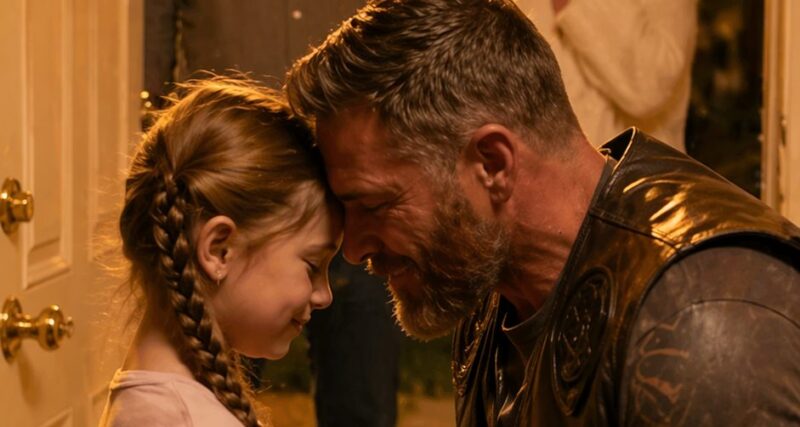
“You’ve got the wrong house,” Eric said at once, his tone sharp and defensive, the bat clearly visible in his hands.
The man at the front didn’t react as I expected. He didn’t glance at the bat, didn’t step forward, didn’t show any sign of intimidation or aggression. Instead, his eyes moved past Eric and settled on me with a steady intensity that was difficult to hold.
Later, I would learn his name—Mason “Graves” Calder. He carried a presence that didn’t need volume to be felt, the kind that quietly shifted the atmosphere of a room just by existing in it.
“We’re not here to cause trouble,” he said calmly, his voice even in a way that felt almost out of place. “We’re here because your daughter came to us.”
At first, the words didn’t fully register. My daughter? Sophie? The idea didn’t fit into the reality I thought I knew.
Eric let out a short, incredulous laugh. “You’ve lost your minds. My kid is upstairs asleep.”
Mason didn’t even look at him. “She rode her bike to our place about an hour ago,” he continued, as though Eric hadn’t spoken. “She said she needed help.”
Something inside me shifted—not breaking entirely, but cracking just enough to let something colder seep in.
“That’s not possible,” I said, though my voice lacked conviction.
Mason’s expression remained unchanged. “She said someone has been coming into her room at night,” he said quietly. “She said she told you. And she said you didn’t believe her.”
There are moments when time doesn’t slow—it collapses. Everything that once felt separate suddenly connects, forming a pattern you can’t ignore. Sophie’s nightmares.
The times she insisted someone had been in her room. The way Eric had dismissed it—quickly, too quickly—calling it imagination, fear, something that would fade if we didn’t “encourage it.”
The air left my lungs.
Before I could speak, there was movement behind us.
I turned.
Sophie stood at the top of the stairs.
She wasn’t crying. She wasn’t afraid the way she had been on those nights when she woke me, trembling, whispering about shadows and sounds. This time, her face was different—calm, focused.
And when she looked past us, toward the men outside, something in her expression made my chest tighten even more.
Relief.
“Sophie?” I said, barely holding my voice together.
Eric reacted instantly. “Go back to bed. Now.”
She didn’t move.
Instead, she stepped down. Then another.
“Don’t,” Mason said quietly—not to her, but to Eric.
Eric froze for just a fraction of a second, but it was enough for me to notice something I hadn’t allowed myself to see before.
Fear.
Not the kind caused by strangers at the door—but something deeper. Controlled. Internal.
“She didn’t come to us just because she was scared,” Mason continued. “She came because she found something.”
I turned back to Sophie, my heart pounding unevenly. “What did you find?” I asked.
She looked at me—really looked at me—and in that moment I realized how long it had been since I had truly seen her, beyond routines, beyond the easy explanations I had accepted.
“I told you,” she said softly. “You said it was just noises. You said Dad was fixing things.”
Eric moved quickly, stepping forward. “She’s confused—”
But Sophie shook her head, and that small motion carried more weight than anything else that had been said.
“No,” she said. “He comes in at night. He said if I told you again, you wouldn’t wake up.”
Some truths arrive loudly. Others settle into you so quietly that you don’t realize they’ve taken hold until you try to breathe—and can’t.
Something inside me shattered.
The danger had never been outside.
It had been standing beside me all along.
Eric moved then—not toward Sophie, not toward me, but toward the side of the house, as if instinct had finally broken through whatever control he had been holding onto. But he didn’t get far. Two of the bikers stepped forward—not aggressively, just enough to block his path.
“Don’t,” one of them said.
And for the first time, Eric stopped pretending.
There was no outburst, no dramatic denial. Just a quiet collapse. A shift in his posture, in his face, in the way he no longer tried to control anything. It was as if the structure he had built around himself had finally crumbled under the weight of being seen.
Then, in the distance, sirens began to rise—growing louder, cutting through the heavy silence that had settled over everything.
I didn’t remember calling them.
Maybe a neighbor had.
Maybe someone from the group had already expected how this would end.
It didn’t matter anymore.
I rushed to Sophie and pulled her into my arms, feeling how small she was—and how steady, despite everything.
“I’m so sorry,” I whispered, the words breaking as they left my lips.
She didn’t cry. She simply held on to me.
The police arrived soon after. Questions followed. Statements were taken. Eric was led away in handcuffs, his face blank and distant, as if he had already stepped away from the version of himself we once knew.
The bikers didn’t stay to witness any of it.
One by one, they stepped back, giving space. Their presence was no longer imposing—almost purposeful, now complete. From the moment they arrived, they had a reason to be there, and once it was fulfilled, they had no need to linger.
Mason paused briefly before leaving. He looked at Sophie, then at me. His expression was difficult to read, but not unkind.
“She did the hardest part,” he said quietly.
I nodded, though I wasn’t sure I deserved to.
Then they were gone. Engines roared to life and faded into the distance, leaving behind a silence unlike the one before. Not empty—just… different.
That night, I stayed beside Sophie until she fell asleep, sitting at the edge of her bed, watching the steady rise and fall of her breathing. My mind replayed every moment I had dismissed, every time I had chosen the easier explanation instead of facing the truth.
Because in the end, that’s what this story is really about.
It’s not about bikers showing up in the middle of the night.
It’s about the cost of not listening when someone you love tells you something is wrong.
Lesson of the story:
The most dangerous truths are often the ones we choose to ignore—not because they are hidden, but because accepting them would force us to face something we are not ready for.
True protection doesn’t come from locked doors or the illusion of normal life—it comes from listening, from believing, and from having the courage to act, even when the truth threatens to shatter everything you thought you knew.