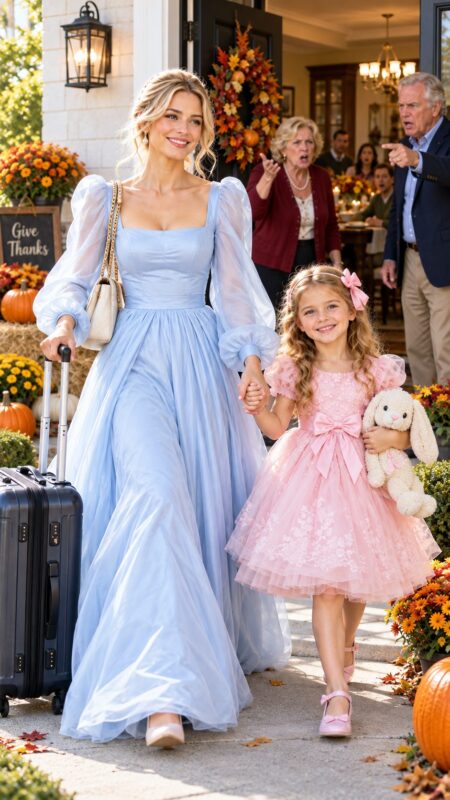
My mother-in-law opened the door, looked at my five-year-old daughter in her Thanksgiving dress, and said, “There isn’t a place for you here.”
Mia squeezed my hand tighter.
In her other hand, she held a paper turkey she had spent the entire morning coloring for Grandpa.
Over Eleanor’s shoulder, I could see the dining room glowing beneath candlelight.
Gold-trimmed plates covered the long table while relatives laughed and talked around enough seating for nearly twenty people.
Two chairs beside the window were empty.
I noticed them immediately.
Eleanor saw where I was looking and gave me a thin smile.
“Those seats are taken.”
“By whom?” I asked.
“By people who are important tonight.”
My stomach knotted.
My husband, Daniel, had arrived earlier with his brother to help get everything ready.
He had assured me that his mother was making an effort to be kinder this year.
He had even asked me not to bring up the previous Christmas, when Eleanor gave every other woman
in the family diamond earrings while handing me a kitchen towel that still had the price sticker attached.
I wanted to believe him.
For Mia, I tried.
Mia lifted her handmade turkey toward Eleanor.
“Grandma, I made this for Grandpa.”
Eleanor barely looked at it.
“Sweetie, Grandpa is busy entertaining the other guests.”
I crouched beside Mia and adjusted the collar of her coat.
“It’s all right, honey. We’re going home.”
Her lower lip began to shake.
“Did I do something wrong?”
That question almost shattered me.
“No,” I told her softly. “You didn’t do anything wrong.”
Eleanor lowered her voice.
“Don’t cause a scene, Claire. You know how delicate today is.”
Delicate.
That was Eleanor’s favorite word whenever she wanted to disguise cruelty as good manners.
The reality was much simpler.
She had never truly accepted me because I had grown up in a working-class family and already had a daughter when I married Daniel.
She smiled beside us in family pictures, but in private she liked reminding me that “blood matters.”
Around other people, she called Mia adorable.
Whenever Daniel wasn’t around, she referred to her as “your child.”
For three years, I had kept my mouth shut because Daniel loved his father, and Frank loved Mia as
though she had been his granddaughter from the day she was born.
Frank Whitmore was the only member of that family who never made Mia feel like she belonged somewhere else.
He called her his little sunflower.
Every drawing she gave him ended up taped or framed somewhere in his office.
And that evening, she had made him a paper turkey covered in orange feathers with crooked letters across the front:
I am thankful for Grandpa.
Eleanor stepped back inside and reached for the door.
“You should leave before dinner begins.”
I picked Mia up.
She pressed her face into my shoulder.
Fifteen minutes later, while I was fastening her into her car seat at a gas station, my phone rang.
It was Daniel’s father.
Frank’s voice was unusually stern.
“Claire,” he said, clearly upset, “turn the car around and come back right now.”
For a moment, I said nothing.
Mia was still quietly crying in the back seat.
“Frank,” I finally answered, forcing myself to stay composed, “Eleanor told us there wasn’t room for us.”
The other end went completely silent.
Then I heard the scrape of a chair.
“She told you what?”
Before I could answer, Frank’s voice boomed across the dining room.
“Eleanor, where are Claire and Mia?”
I could hear everything through the phone.
Someone muttered something nearby.
Then Eleanor answered, her voice distant but unmistakable.
“They decided they didn’t want to come.”
I shut my eyes.
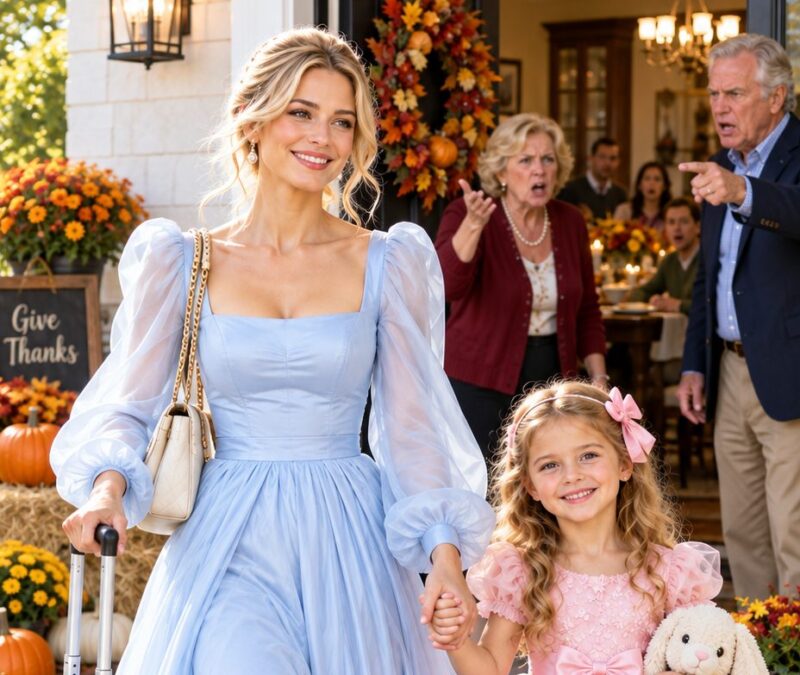
From the back seat, Mia whispered, “That isn’t true.”
Frank heard her.
The silence afterward was more powerful than yelling.
“Claire,” he said, “please come back. I want everyone sitting at this table to hear what your daughter just said.”
My first instinct was to refuse.
I wanted to take Mia home and pretend Thanksgiving was nothing more than an ordinary Thursday.
Then she held up her paper turkey, one corner now bent.
“Can Grandpa still have this?”
That was enough.
I turned the car around.
When we returned to the Whitmore house, nobody had started eating.
Every guest was already seated.
Daniel stood beside the fireplace looking pale and completely confused.
Eleanor remained near the table without saying a word.
Frank stood at the head of the room holding Mia’s booster seat.
He had positioned it directly next to his chair.
Not at a separate kids’ table.
Not somewhere near the kitchen.
Right beside him.
“Mia,” he said warmly, “bring me your turkey.”
She ran straight toward him.
Frank accepted the drawing as carefully as though she had handed him an official contract.
Then he faced the entire family.
“My wife told a five-year-old girl that there was no place for her inside a house that belongs to me, at a table I paid for, during a holiday I personally invited her to attend.”
Eleanor’s voice dropped to a whisper.
“Frank, please don’t humiliate us.”
He looked directly at her.
“You humiliated this family the second you made a child believe she wasn’t welcome.”
Then Frank reached for a folder beside his plate.
Eleanor’s face changed immediately.
“Frank,” she warned, “not tonight.”
He pulled out a document.
“This,” he said, “is the guest list Eleanor submitted to the caterer.”
My name had been crossed out.
So had Mia’s.
Next to our names, written in Eleanor’s handwriting, were three words:
Daniel’s temporary mistake.
Daniel stared at the page as if he couldn’t process what he was seeing.
I didn’t look at Eleanor.
I watched my husband.
Because now the choice belonged to him.
His eyes became glassy.
“Mom,” he said, “Claire is my wife. Mia is my daughter.”
Eleanor answered coldly, “She isn’t your blood.”
Daniel walked toward Mia, crouched beside Frank’s chair, and looked at her.
“She became my daughter the first night she asked me to look under her bed and make sure there weren’t any monsters.”
Mia gently touched his cheek.
Frank reached into the folder again and removed another document.
“I intended to discuss this after dessert,” he said, “but sometimes circumstances change the schedule.”
It was a revised version of the family trust.
Under the new terms, the house, the lake cabin, and Frank’s voting shares in Whitmore Construction would eventually be transferred jointly to Daniel and me.
There was also a protected education fund established specifically for Mia.
Eleanor’s discretionary spending account, meanwhile, was being reviewed after Frank discovered that
she had been using family money to encourage one of Daniel’s former girlfriends to attend family holidays.
Eleanor shoved her chair backward.
“You’re choosing them over your own wife?”
Frank didn’t look furious anymore.
He simply looked tired.
“No,” he said quietly. “I’m choosing basic decency over manipulation.”
Not a single person defended her.
A few moments later, Daniel’s brother admitted that Eleanor had specifically instructed him not to arrange seats for Mia and me.
We stayed for Thanksgiving dinner because Frank asked us to.
And because Mia wanted nothing more than to sit beside her grandfather.
Eleanor barely touched her food.
By Monday, she had moved into the guesthouse.
Several weeks later, Frank had Mia’s paper turkey professionally framed and hung it on his office wall.
Beneath it, he attached a small brass plaque that read:
There is always space for love. There is never space for cruelty.
Mia read the words aloud and smiled.
That Thanksgiving taught my daughter something painful about the way some people behave.
But it also taught her something far more important.
Some people close doors because they want you to feel excluded.
The people who truly love you make sure those doors are opened even wider.