My thirteen-year-old son took a weekend dishwashing job to save for a new bike. Six months later, the bike still hadn’t appeared.
Then his boss called me and asked, “Do you know what Evan does with every paycheck?”
I told him my son was saving for a bicycle.
The man went silent.
“Ma’am, you need to sit down. Everything your boy has told you about that money is a lie.”
Evan had wanted the same matte-black bicycle with orange lettering for months.
After his father died three years earlier, he seemed to grow up overnight. He watched me worry about bills and stopped asking for expensive things.
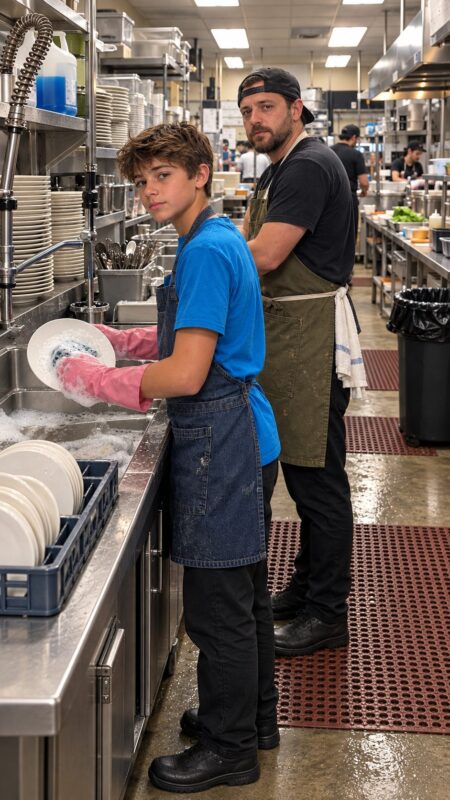
So when he found a Saturday job at a neighborhood diner, he proudly announced, “I’m buying the bike myself.”
Every Saturday he came home smelling like dish soap and fryer grease. Whenever I asked about the bicycle, he said, “Almost there.”
But after six months, there was still no bike.
One night I saw him counting a thick stack of cash in his bedroom. The moment he noticed me, he shoved it into his backpack.
A few weeks later, he came home late, covered in mud, with a torn sleeve and a scrape on his face. He claimed he had fallen near the creek.
Something felt wrong.
Then his boss, Sal, called.
“Do you know what your son does with every paycheck?”
“He’s saving for a bicycle.”
“No,” Sal replied. “He isn’t.”
Before I could ask more, I heard Evan in the background shouting, “Please! Don’t tell my mom!”
Sal told me to come immediately.
When I reached the diner, Evan stood beside his open backpack.
Scattered across the floor were grocery receipts, bus cards, children’s gloves, crayons, envelopes, and a battered notebook.
Inside were pages of expenses:
Groceries.
Bus passes.
Winter shoes.
Electric bills.
Meals.
“Your son gives his paychecks away,” Sal explained.
It had started when Evan noticed a mother dividing one diner meal between her two sons while pretending she had already eaten.
Evan secretly paid her bill.
Then he bought a bus pass for a coworker walking miles to work.
He bought winter shoes for a waitress’s daughter. He helped customers counting coins and classmates wearing torn gloves.
Eventually employees and customers discovered what he was doing and began contributing money.
The cash I had seen in his bedroom wasn’t his.
It belonged to their secret fund.
And the muddy clothes?
Evan had crossed the creek carrying groceries to a struggling family and slipped down the bank.
But that day, Sal had stopped Evan from doing something bigger.
A waitress with three children had lost most of her belongings after a burst pipe flooded her apartment. Evan had brought hundreds of dollars to help her.
His own money.
The savings he had finally kept for his bicycle.
“She needs it more than I need a bike,” Evan whispered.
Then I asked why he had chosen that particular diner.
Sal became quiet.
He returned from his office carrying an old cash box filled with photographs, receipts, and handwritten notes.
Then he handed me an index card.
I recognized the handwriting instantly.
It belonged to my late husband.
Years earlier, my husband had been a regular customer there.
Whenever he had extra money, he secretly left ten or twenty dollars behind so Sal could feed someone who couldn’t afford a meal.
He called it the “extra chair.”
“If your table has enough food,” he used to say, “there should always be room for one more.”
After my husband died, mysterious grocery bags, gift cards, paid bills, and Christmas presents had appeared at our house.
Now I finally learned where they came from.
The people my husband had helped had quietly helped us in return.
Evan discovered the story after asking Sal for a job.
“I wanted to keep it going,” he said.
“Why didn’t you tell me?”
His answer broke my heart.
“Because Dad didn’t tell anyone either.”
I hugged him and reminded him that generosity didn’t mean giving away everything he owned.
The next Saturday, Sal asked us to come to the diner early.
Nearly fifty people were waiting outside.
Then the crowd moved aside.
There sat Evan’s dream bicycle.
Matte black.
Orange lettering.
Customers, employees, neighbors, and the sporting-goods-store owner had all contributed.
Taped beneath the seat was an orange envelope containing his father’s old index card.
Below his father’s message, Sal had written:
“Your dad left an extra chair. You made the table bigger.”
Evan cried.
So did I.
Today, that bicycle sits in our garage.
Evan still works Saturdays, but now part of his paycheck goes into savings, part is his to enjoy, and part can go toward the extra-chair fund.
For six months, I thought my son was hiding trouble.
I never imagined he was hiding kindness.
Maybe kindness really does come back.
It just doesn’t always take the same road home.