My name is Mariana, and until one life-changing afternoon, I believed I understood both my husband and the world around me.
Alejandro was a wealthy Chicago businessman who regularly supported charitable causes.
That week, he volunteered at a soup kitchen because he wanted to help people personally instead of merely writing checks.
I mocked his enthusiasm and claimed that some homeless people simply preferred living that way.
When I returned home from lunch, Alejandro was standing beside an elderly homeless woman named Lucy.
She was unable to remember her real identity and said her earliest memory was waking among construction rubble twenty years earlier.
Since then, she had survived in stations, parks, shelters, and abandoned buildings.
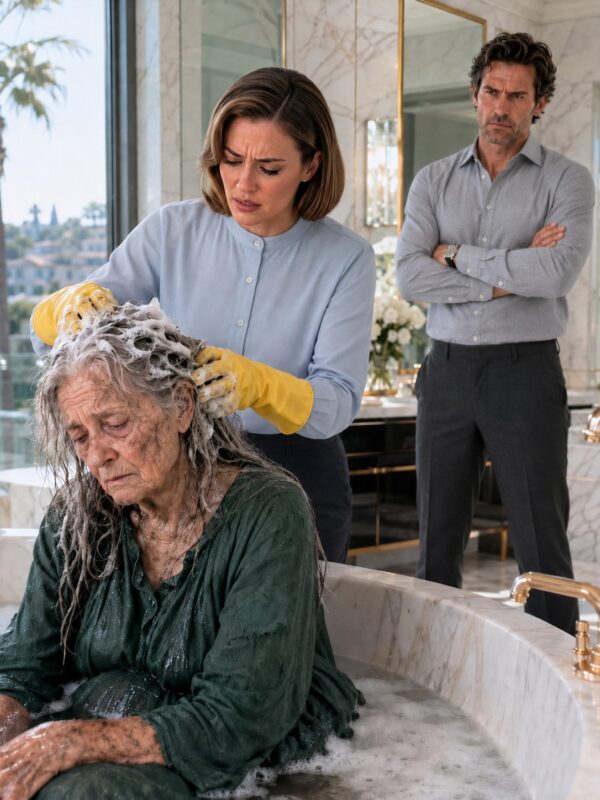
Alejandro announced that Lucy would temporarily stay in our guest suite.
Then he ordered me to help her bathe without calling the staff.
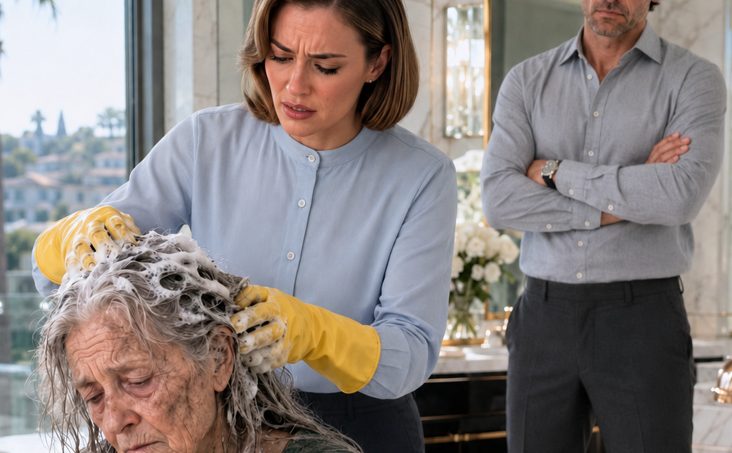
Angry and disgusted, I led Lucy upstairs and put on rubber gloves.
I spoke coldly to her and worried more about my marble bathtub than her dignity.
As I washed her right shoulder, however, the dirt revealed a crescent-shaped birthmark.
I froze.
Frantically cleaning her face, I began recognizing the woman beneath the grime.
I opened a drawer and removed a gold locket containing a photograph of my mother and me.
“Your name is Lucile,” I whispered. “You’re my mother.”
When I was ten, I had been told my mother died in a house fire.
No body was recovered, but everyone believed survival was impossible.
Now, after twenty years, she was sitting alive in my bathtub.
Unfortunately, she did not remember me.
Alejandro admitted that he had suspected Lucy’s identity after noticing her age and a scar matching one my mother had.
Afraid of giving me false hope, he brought her home so I could discover the truth myself.
A neurologist diagnosed Lucile with trauma-related amnesia.
He advised us not to force her memories but to surround her gently with familiar sounds, smells, photographs, and places.
I baked her cinnamon rolls, played her favorite jazz records, and took her to a childhood park. For weeks, nothing worked.
Then we visited the neighborhood where our old house had stood.
While we walked nearby, a truck suddenly came toward the sidewalk.
I froze, but my mother instinctively pushed me to safety.
The shock unlocked her memories.
“Marianita,” she cried—the childhood name no one had used in twenty years.
She remembered everything, including my father’s death.
I had always believed he died because I ran into the street as a child.
My mother explained that he had deliberately saved me from an approaching car.
He had not died because of me; he had given his life for me out of love.
She also remembered the fire. After an explosion, she escaped through a broken window but suffered injuries and complete memory loss.
A truck driver found her far from home and brought her to a rural clinic.
Without identification or memories, she spent two decades moving between shelters and streets, slowly drifting back toward Chicago.
In the following months, more memories returned.
Meanwhile, I confronted the shameful truth that every cruel assumption I had made about homeless people also applied to my own mother.
She had not chosen her circumstances.
One terrible event had taken away her identity, family, and security.
I began volunteering beside Alejandro at the soup kitchen.
We also found Theresa, a bus-terminal cleaner who had secretly given my mother food, coffee, and shelter.
Alejandro helped Theresa open a tailoring shop, while our family created a foundation that reunited unidentified homeless people with their documents and relatives.
I tried to compensate for my mother’s lost years with expensive clothes and jewelry, but she refused.
“I don’t need luxury,” she said. “I just want breakfast with you.”
That taught me the story’s greatest lesson.
People do not always need pity or possessions.
Sometimes they need food, safety, time, and someone willing to see their humanity.
The woman I once treated like a burden was my own mother.
She needed only a warm meal, an open door, a bath—and someone willing to look closely enough to recognize her.